|
|||||||||||||
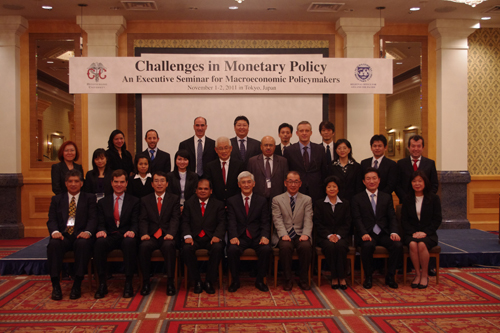
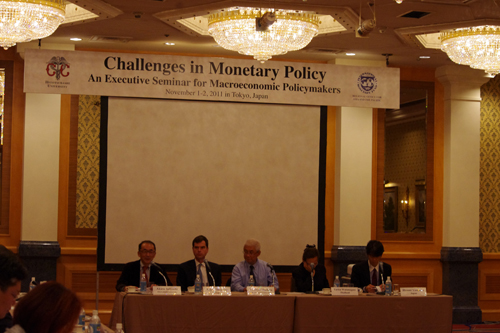
Challenges in Monetary Policy Hitotsubashi University and the International Monetary Fund’s Regional Office for Asia and the Pacific (OAP) jointly hosted a seminar for senior policy makers from Asia on the recent challenges facing monetary policy. The seminar’s aim was to bring together senior macroeconomic policy makers from across Asia to learn about and to discuss theoretical and practical aspects of policy challenges faced by central banks. The main issues that were considered were monetary policy responses in financial crisis, monetary policy for price stability and the inflation targeting framework, and the monetary policy role in financial stability.
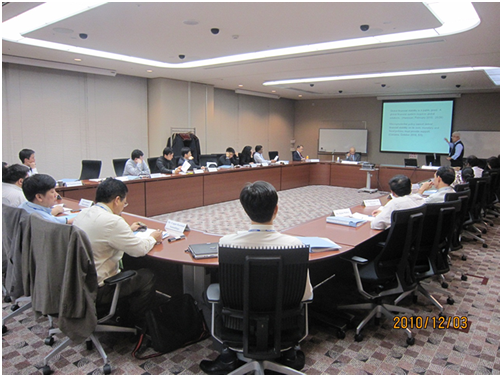
Summary of Discussions Much of the discussions in Session 1 revolved around the spillover effects, with participants variously expressing the need for foreign exchange provision during crisis, the limited domestic effect of monetary policy beyond the ‘acute pain’ stage of crisis as opposed to the larger spillover effects, and the limited ability of foreign authorities to manage capital flows caused by these spillovers. In Sessions 2 (lecture by Professor Yasuhiro Maehara of Hitotsubashi University) and Session 3 (lecture by Executive Director Kenzo Yamamoto of the Bank of Japan), the participants agreed with the lecturers that both price and financial stability were important, and that the goals need to be pursued in a flexible manner. There were some questions as to how to specifically and systematically incorporate longer-tern financial stability impacts into the inflation-targeting based monetary policy framework. Issues in identification of risks, communication of policy, and maintenance of credibility were underscored in the discussions. The round-up Panel comprising the session lecturers (substituted by Mr. Yamaoka from BOJ for Mr. Yamamoto) and Former Bank of Thailand Governor Tarisa Watanagase (who led off with a presentation) discussed the issue of how to balance price stability and financial stability concerns, and the appropriate institutional and governance structures to best respond to these needs. There was a broad agreement that central banks had the expertise and synergies to best handle price stability and macro-prudential tasks, though some cautioned the political challenges of managing macro-prudential policies. There was a general feeling that, despite the difficulties and risks to central bank independence, central banks must face these challenges head on. A dinner Q&A session with Governor Shirakawa of the Bank of Japan was also held. In responses to questions from the participants, the Governor made very thoughtful and insightful comments on his perspectives on the issue of large level of government debt in Japan, the state of the U.S. economy, the effect of yen appreciation, consequences of demographic transition and the international monetary system. The Program of the event can be found here:[Challenges in Monetary Policy] The IMF-OAP website (http://www.imf.org/external/oap/index.htm) also contains the presentation by lecturers.
Hitotsubashi Executive Program for Macroeconomics Policymakers In 2005, the APPP began an Executive Program for Macroeconomic Policymakers of Asian governments with the funding support of the International Monetary Fund and cooperation from the Public Economics Program of the School of International and Public Policy. The Executive Program aimed to provide senior officials of Asian governments and central banks involved in macroeconomic policymaking with an opportunity to keep abreast of the latest research outcomes and academic thinking in macroeconomics and their relevance for policymaking. It gave participants in-depth perspectives on important issues affecting the Asian region and the global economy. Furthermore, the Program afforded participants opportunities for frank and open exchanges of views and experience to identify the issues of common concern in economic policymaking.
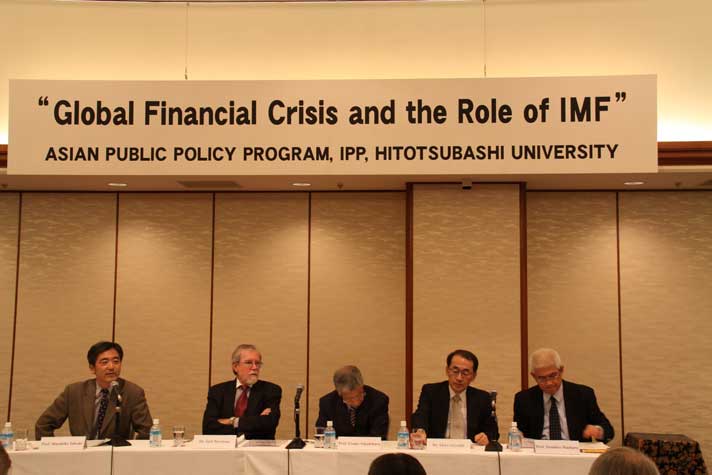
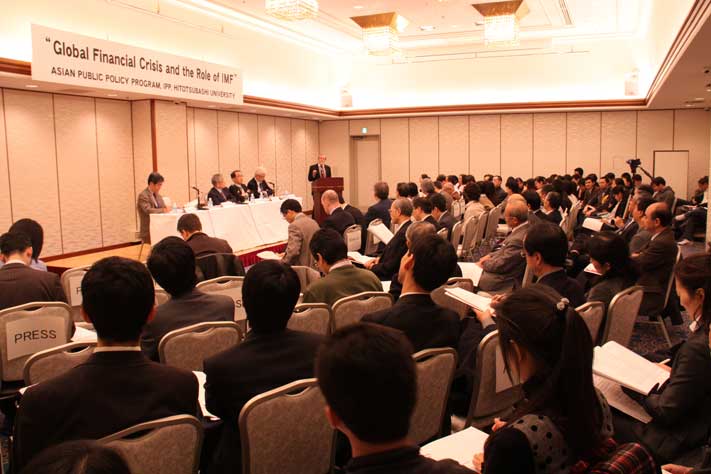
Open Seminar on the Global Financial Crisis On December 16, APPP sponsored an open seminar on the “Global Financial Crisis and the Role of the IMF”. The keynote speaker was Dr. Jack Boorman, who served as Head of the IMF’s Policy Development and Review Department for many years, and the panelists were Prof. Eisuke Sakakibara of Waseda University (former Vice Minister of Finance for International Affairs), Mr. Akira Ariyoshi (Director of the IMF Regional Office for Asia and the Pacific), and APPP’s Prof. Yasuhiro Maehara. The seminar was moderated by APPP’s Prof. Masahiko Takeda. The audience, which numbered more than 100, included academics, current and former government officials, think tank economists, the press, and APPP and other students.
How to reform international
financial institutions─and the IMF in
particular─is a salient topic in the context
of coping with the ongoing global financial crisis and preventing its
recurrence. Dr. Boorman presented an ambitious list of steps to
strengthen the IMF, such as an SDR allocation, a substantial quota
increase, governance reform, and giving the IMF a new mandate on capital
account transactions. While no fundamental disagreement was voiced by
the panelists, they expressed caution on some of the steps proposed by
Dr. Boorman. During the Q&A session that followed, the audience raised
questions about the IMF’s role during the Asian Crisis, the seeming
asymmetry of the IMF’s advice between developed and developing
countries, and possible alternatives to the IMF such as the Chiang Mai
Initiative.
|
|||||||||||||







|
Copyright © 2011, Tokyo, Japann |
|
Hitotsubashi University |